
Key takeaways:
-
NHS breast screening begins with an invitation between your 50th and 53rd birthday and repeats every three years until you turn 71
-
At Scan.com, private breast screening mammograms are available for women over the age of 40 and start at £395
-
Screening is only suitable for women with no breast symptoms. A new lump, a nipple change or a change in the skin needs an urgent GP appointment instead
-
Around 96 out of every 100 women screened on the NHS programme need no further tests, while around four are recalled. Of these four, three won’t have breast cancer
-
Breast screening sometimes misses cancer, and sometimes it picks up abnormal cells and leads to treatment for a condition that might never have become life-threatening
The NHS provides a free breast screening programme every three years for women aged between 50 and 71. Private breast screening is typically available from 40 years old, a decade before NHS screening begins, and is offered every year.
Choosing to have a private breast screen will depend on your age, breast health and family history.
This guide covers what you can book, when, how much it costs and what a result will and will not tell you.
What Breast Cancer Screening Involves
A breast screen is called a mammogram. A mammogram is an X-ray of the breast tissue and is the same test whether you have it on the NHS or you book privately.
During a mammogram, you’ll be asked to stand in front of a scanning machine. A medical professional called a mammographer places one breast on a plate, then a second plate presses down to hold the tissue still and spread it out. This is called compression. The machine takes two images of each breast: one from above and one from the side. Each compression lasts a few seconds.
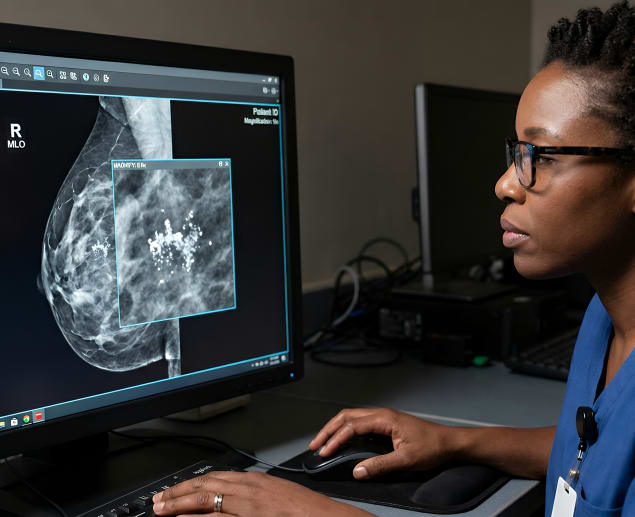
A specialist then reviews the images for abnormalities and signs of change.
Screening a Healthy Breast Versus Investigating a Symptom
Breast screening is a routine appointment meant for X-raying the breasts of women with no known symptoms. A screening mammogram can find cancers that are too small to notice, or larger cancers deep within the breast tissue, in breasts that appear entirely normal.
If you have breast symptoms, such as a lump, puckering of the nipple, nipple discharge or changes to the skin of your breast or nipple, don’t wait for an NHS screening appointment or book a private one. Make an urgent appointment to see your GP, even if you’ve recently had a mammogram.
Screening is inappropriate for investigating symptoms, and it may delay the right tests and treatment.
Who Private Breast Screening Is For
Private breast screening is for any female over the age of 40 who doesn’t have any breast symptoms.
Family History and Known Genetic Risk
If breast or ovarian cancer runs in your family, speak to your GP if you’re concerned about your risk.
If suitable, your GP can refer you to a genetics or oncology specialist to properly assess your risk. If you’re assessed as being at high risk, the NHS offers surveillance screening. This happens more often than every three years and can start before age 50. It may also combine regular mammograms with breast MRI scans, depending on your age and the reason for your risk.
Women Under 50 Who Are Not Yet Invited by the NHS
Your first NHS invitation will arrive between your 50th and 53rd birthday. Private mammograms are generally available from the age of 40.
Breast cancer risk increases with age and becomes more common over the age of 50, which is why the NHS starts its national programme of routine screening from 50 years old.
Younger women tend to have denser breast tissue (more glands and fibrous connective tissue, with very little fat), which can be harder to read on a mammogram. Breast cancer is rare under the age of 30, and mammograms in women under 50 can lead to false positives (see below) and overdiagnosis.
However, compelling evidence now supports earlier screening. Women under 50 are currently offered no breast screening unless they have a strong family history of breast cancer. But this ignores women under 50 who have an above-average risk due to non-inherited risk factors, including obesity and high alcohol intake. Researchers warn that up to 95% of those at higher risk of developing breast cancer under 50 could be missed. This BBC article can help you find out more about your potential risk.
Opting to have a mammogram between the ages of 40 and 50 is a personal choice between accepting a higher risk of a false alarm in exchange for an earlier chance of finding something harmful.
Women Over 71 Who No Longer Receive Invitations
NHS invitations stop after your 71st birthday, but the screening doesn’t. If you’re over 71, you can still have a routine breast screen every three years, but you need to request one via your GP or by contacting your local breast screening service. If you’re on active surveillance, you can still request an annual mammogram.
You can still request a private breast screen every year if you’re aged 71 or over.
Dense Breast Tissue
Dense breasts contain more fibrous and glandular tissue and less fat. Around 10% of women have very dense breasts, and although more common in younger women, you can have dense breasts at any age.
Having dense breasts raises your risk of breast cancer, and you may be four times more likely to develop it between the ages of 50 and 70. Dense breast tissue also makes cancer harder to see, because dense tissue and tumours both appear white on a mammogram.
You cannot feel whether your breasts are dense, and the NHS does not routinely tell you.
A study called the BRAID trial, led from Cambridge and published in The Lancet in 2025, tested extra breast scans in more than 9,000 women with dense breasts whose mammograms had come back clear.
Specialist scans called contrast-enhanced mammography and abbreviated MRI each found cancers that the routine mammograms had missed, roughly tripling detection in this group. Neither technique is routinely used in NHS breast screening yet, but some private scanning centres do offer them.
Breast Implants and Previous Breast Surgery
You can have a mammogram with implants. Your mammographer will use modified positioning to image as much of the surrounding natural tissue as possible. However, implants do obscure some of it.
Tell your imaging centre you have implants when you book, not when you arrive. The same goes for a pacemaker or any other implanted device, a previous mastectomy and any mammogram you have had in the past six months.
If you’ve had breast surgery or a previous mammogram, provide details and any scan images if you have them when you book a mammogram. This will allow your medical team to compare the images and spot changes that a single image cannot show.
Trans and Non-Binary Patients
If you’re registered as female with your GP surgery, NHS invitations will arrive automatically between your 50th and 53rd birthday. If you’re registered as male, they won’t be sent automatically, but you can still ask your GP for screening.
Trans men who haven’t had top surgery can have mammograms. After top surgery, some breast tissue usually remains, but a mammogram isn’t always possible. So it’s important to be aware of changes in your breasts, and if you notice any, make an urgent appointment to see your GP.
Feminising hormones raise breast cancer risk, so trans women who have been taking them for more than two years can have breast screening. Ask your GP surgery or contact your local breast screening service directly.
The Available Breast Scans and When They’re Used
Most private breast screening is a standard 2D digital mammogram. Some providers offer more, but usually only if you have breast cancer symptoms.
2D Digital Mammography
The standard breast screen, and the one the NHS programme uses. 2D digital mammography captures two X-ray views per breast on a digital detector and has specialists read them.
3D Mammography (Tomosynthesis)
Tomosynthesis takes a series of low-dose images across the breast and reconstructs them into thin slices, so a reader can move through the tissue layer by layer rather than studying a single flattened image. Overlapping tissue is then less likely to hide or imitate something.
3D mammography is not nationally approved for breast screening. It’s performed only on symptomatic patients, and only when a breast surgeon specifically requests it.
Breast Ultrasound
Ultrasound scans use high-frequency sound waves and involve no radiation. They're not routinely used as a standalone breast screening test in the UK.
Instead, they're used to analyse something detected on a mammogram, as they can distinguish between a fluid-filled cyst and a solid lump. They’re also used alongside mammography to screen very dense breast tissue.
Ultrasound can miss microcalcifications, the tiny flecks of calcium that can be the earliest visible sign of some breast cancers and that show up clearly on a mammogram.
Breast MRI
Breast MRI is the most sensitive breast imaging test available, and the NHS uses it for high-risk surveillance rather than routine screening.
During an MRI of the breasts, you’ll be asked to lie face down on a table with your breasts in cushioned openings. The scan takes between 30 minutes and an hour and involves an injection of a gadolinium-based contrast agent, which makes tissue with a rich blood supply stand out.
Breast MRI scans are not routine and can detect things that then need to be analysed and turn out to be nothing serious. They’re not used in asymptomatic patients (those with no symptoms) and are reserved for high-risk patients.
Contrast-Enhanced Mammography
Contrast-enhanced mammography (CEM) is a mammogram performed after an injection of an iodine-based contrast agent. Tumours tend to have a dense blood supply, so the contrast makes them stand out against dense tissue that would otherwise conceal them.
A small number of UK private clinics offer CEM, typically to women already known to have dense breasts, but it isn’t generally offered as a standard screening scan for asymptomatic women.
Which Test Suits Which Patient
Which breast screening is right for you depends on your health and is decided by your doctor, whether you’re under the NHS or paying privately. But generally speaking:
-
No symptoms, aged 40 or over, no known risk factors: mammogram
-
No symptoms, known dense breasts: mammogram, plus a conversation about supplemental imaging such as ultrasound
-
Assessed as high risk by a genetics or oncology specialist: NHS surveillance, usually MRI, mammography or both
-
A lump or any other symptom, at any age: GP first, then whatever imaging they arrange
-
Under 40 with a symptom: usually ultrasound first, because younger breast tissue tends to be denser
How the NHS Breast Screening Programme Works
Ages, Intervals and How Invitations Arrive
Everyone registered with a GP surgery as female is invited. Your first invitation will arrive between your 50th and 53rd birthday, then every three years until your 71st birthday.
Invitations are sent to the contact details your GP surgery holds, so make sure your address and phone number are up to date. If you’re 53 or older and haven't been invited, contact your local breast screening service directly.
Appointments take place in hospitals, dedicated screening units and mobile vans, often parked in large local car parks. The equipment and the standards are the same in all three.
High-Risk Surveillance on the NHS
Surveillance is the term used to describe screening people already known to be at increased risk. It happens more often than every three years and starts earlier.
You may be offered a mammogram, a breast MRI or both. What you’re offered will depend on your age and the reason for your risk. At 50, you may transition from annual surveillance to every three years.
All invitations stop at 71, surveillance included, but you can still request appointments after that.
NHS Screening or Private Screening: How to Decide
Paying for a private breast screen may help you start screening earlier and more frequently. The imaging itself is to the same standard as the NHS.
Whether you pay privately is up to you. If you're in your 40s with no symptoms, no family history and no high-risk factors, you gain a few years of being screened, which might catch something earlier. But you’ll also have a higher chance of being recalled for something benign, in an age group where that happens more often, plus the small risk of repeated radiation exposure.
If you’re approaching 71 and have been regularly screened every three years, you may benefit more from having more regular mammograms, when your risk of developing breast cancer is higher than when you were younger.
Booking a Private Breast Screening Without a GP Referral
No referral is needed with Scan.com. Book online, your scanning centre confirms your appointment by phone to check you’re suitable, and you attend.
You need to be 40 or over, not pregnant and not breastfeeding, free of breast symptoms and without a mammogram in the past 12 months.
If you’re unsure whether a mammogram is the right test, we offer a £50 consultation call with a Scan.com GP who can advise and, if imaging is recommended, write a referral, with no obligation to book anything.
How to Prepare for a Private Mammogram
Having a mammogram doesn’t require much special preparation, but keep a few things in mind:
-
Skip spray deodorant and talcum powder in the days before your appointment because the particles can appear on a mammogram and mimic calcifications. Roll-on deodorant is fine.
-
Wear a top with a skirt or trousers. You will need to undress to the waist, and a dress or jumpsuit means you'll need to undress completely.
-
Remove necklaces and nipple piercings before you arrive.
-
Tell the centre in advance about implants, a pacemaker or other implanted device, previous breast surgery or any mammogram in the last six months.
-
If your breasts are tender at certain times in your menstrual cycle, book your appointment around that.
You can eat, drink and take your medication as normal.
What Happens on the Day
When you arrive for your private mammogram, your female mammographer will greet you. They’ll check your details, ask whether you have had any breast problems and explain each stage before it happens. Then you’ll be asked to undress to the waist while they wait outside.
Your mammographer will position one breast on the scanning machine, and an upper plate comes down to compress the tissue. They’ll step behind a screen to avoid repeated X-ray exposure, and you’ll need to hold still for a few seconds while the image is taken. The machine is then angled for the second view, and the whole process repeats on the other side.
The compression is uncomfortable for most women and painful for some, but the scan is over in seconds, and you can ask to stop at any point. If the compression hurts, tell your mammographer.
Your appointment should take about 30 minutes.
Radiation Dose and Safety
All X-rays, including a mammogram, use radiation, and radiation exposure can very slightly increase your risk of developing cancer later in life. A mammogram exposes you to a very low dose of radiation, and the benefits far outweigh the risks.
UK screening units operate under the Ionising Radiation (Medical Exposure) Regulations 2017, which require that every exposure be justified and kept as low as reasonably practicable.
The Limits of Screening
No screening test is completely reliable. Mammograms can lead to false positives and false negatives.
False Positives
A false positive is a recall for another mammogram to investigate a finding that turns out to be nothing. Three out of every four recalls are false positives, and they can understandably lead to anxiety and stress.
False Negatives and Interval Cancers
Mammograms miss some cancers. Dense breast tissue is the most common reason, and cancer can also develop in the gap between one screening and the next.
A cancer diagnosed between screening appointments is called an interval cancer. It’s why a clear mammogram does not mean you can stop paying attention to your breasts, and why you should attend a mammogram when invited. If you notice any changes, regardless of when you last had a mammogram, make an urgent appointment with your GP.
Overdiagnosis and Overtreatment
Some cancers found by breast screening would never have caused symptoms or become life-threatening. Therefore, each year, a number of women end up being treated for something that was never going to harm them, because once a cancer is diagnosed, treatment is always offered.
The Independent UK Panel on Breast Cancer Screening estimates that screening reduces breast cancer mortality by about 20%, which works out at roughly 1,300 deaths prevented a year across the UK. It also estimates that around 4,000 cases are overdiagnosed each year.
Per 10,000 women invited to screening from age 50 for 20 years, the panel put the figures at 43 breast cancer deaths avoided and 129 cancers overdiagnosed.
What Private Breast Screening Costs
Private mammogram prices in the UK generally range from around £200 to £400, depending on the provider, location and whether the price covers imaging alone or a full package of care.
A private mammogram with Scan.com starts at £260 and includes your referral, a scan at a centre of your choice and digital access to your report. Costs vary between individual scanning centres.
When to See a GP Instead of Booking a Screening Scan
Ask for an urgent GP appointment if you notice:
-
a lump or swelling in your breast, chest or armpit
-
a change in the skin, such as dimpling, redness or an orange-peel texture
-
a change in the size or shape of one or both breasts
-
nipple discharge, particularly if it contains blood
-
a nipple that has pulled inwards, or has a rash
-
breast or armpit pain that is there all or almost all of the time
Most of these turn out not to be cancer. But they still need to be investigated, and a screening mammogram is not the way to do it.
Book a Private Breast Screening
If you’re 40 or over, have no breast symptoms and would rather not wait for an NHS invitation, you can book a private mammogram with Scan.com without a GP referral. Choose a scanning centre near you and book online. Your report will be available within a few days and will be verified by two consultant radiologists.
More Information
-
NHS: breast screening (mammogram) covers eligibility, the appointment and results for the national programme.
-
Your guide to NHS breast screening (GOV.UK) is the leaflet sent with invitations, and it sets out the benefits and the harms side by side.
-
Breast Cancer Now runs a free helpline on 0808 800 6000 for questions about breast health and screening.
FAQs
At What Age Can I Have a Private Breast Screen?
Most UK private providers, including Scan.com, screen women from the age of 40. That’s ten years earlier than the first NHS invitation, which arrives between 50 and 53. Private screening has no upper age limit. If you’re under 40 and worried about your family history, speak to a GP about a risk assessment rather than booking a mammogram, because younger breast tissue is harder to read.
How Often Should I Have a Private Mammogram?
Private providers generally allow one screening mammogram every 12 months to minimise your risk of repeated X-ray exposure. The NHS programme screens every three years.
Do I Need a GP Referral for a Private Mammogram?
No. Scan.com and most other private providers accept self-referrals, so you can book online without seeing a GP first. You must meet the eligibility criteria: be 40 or older, have no breast symptoms, not be pregnant or breastfeeding and not have had a mammogram in the past 12 months. If you have symptoms, see your GP as a screening booking will usually be declined.
Can I Have a Mammogram If I Have Breast Implants?
Yes. Mammography can be performed with implants using modified positioning that images as much of your natural breast tissue as possible. Implants do obscure some tissue, which is a limitation to keep in mind. Tell the scanning centre when you book, rather than on the day, so they can plan the appointment and use the right technique.
Will a Private Mammogram Affect My NHS Screening Invitations?
No. A private mammogram does not remove you from the NHS Breast Screening Programme, and you will continue to receive invitations on the usual three-yearly cycle. The two records are separate, so it helps to tell each service about imaging done by the other. Screening units can often retrieve previous images from another UK provider for comparison.
References
NHS. (2025). Breast screening (mammogram). https://www.nhs.uk/tests-and-treatments/breast-screening-mammogram/
NHS England. (2026). Your guide to NHS breast screening. GOV.UK. https://www.gov.uk/government/publications/breast-screening-helping-women-decide/nhs-breast-screening-helping-you-decide
NHS England. (2025). Breast screening for women with a high risk of breast cancer. GOV.UK. https://www.gov.uk/government/publications/nhs-breast-screening-high-risk-women/breast-screening-for-women-with-a-higher-risk-of-breast-cancer
Independent UK Panel on Breast Cancer Screening. (2013). The benefits and harms of breast cancer screening: an independent review. British Journal of Cancer. https://www.nature.com/articles/bjc2013177
Cancer Research UK. (2025). Enhanced breast cancer screening could help more women with dense breasts. https://news.cancerresearchuk.org/2025/05/22/dense-breasts-enhanced-breast-cancer-screening/