Impacted Wisdom Teeth
Wisdom teeth that cannot push through the gum due to a lack of space or growing at the wrong angle.
If your dentist has recommended an OPG scan, book quickly and easily with one of our dental imaging specialists.
If you're not sure which kind of dentistry scan you need, speak to our friendly clinical team.
Book a consultation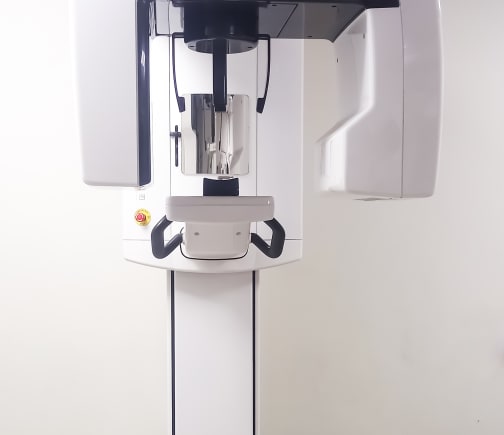
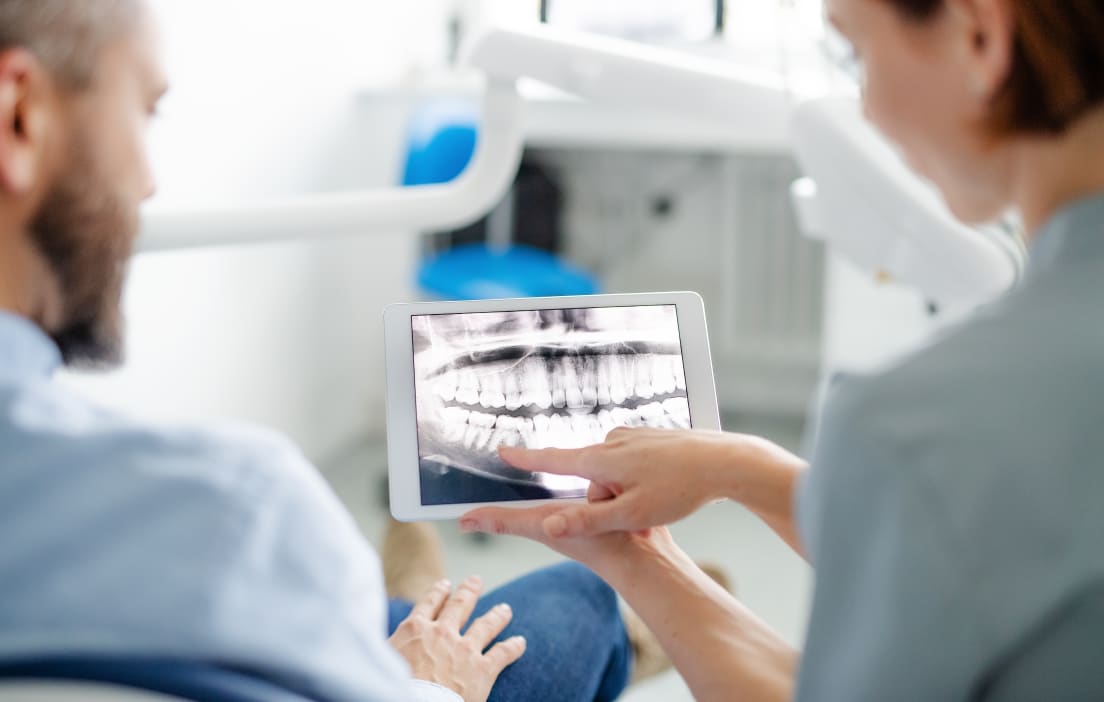
An orthopantomogram is a specialised type of dental X-ray. Also known as a panoramic X-ray, unlike a regular “bite” X-ray conducted at a dental practice that focuses on one or two teeth, an OPG X-ray captures a panoramic view of the entire mouth in a single, 2D image.
OPG scans produce detailed images of the teeth, jaws and the temporomandibular joint (TMJ) where your upper and lower jawbones meet. They also provide a snapshot of the sinuses and nasal cavity.
An OPG scan is carried out at a dedicated imaging clinic or hospital, as it requires specialist equipment not typically available in a regular dental practice. Your dentist may refer you for an OPG X-ray to help them diagnose certain conditions affecting your teeth, mouth or jaw, or to help them plan dental surgery or orthodontic procedures:
Wisdom teeth that cannot push through the gum due to a lack of space or growing at the wrong angle.
Pain and clicking in the jaw can be caused by grinding your teeth, clenching your jaw, fractures, cysts, infection or changes in bone health due to arthritis. OPG scans help dentists discover the cause.
OPG scans are useful for assessing injuries and damage to the face and jaw after an accident.
Some infections, cysts and abscesses can be hidden in the gums, under fillings or between teeth and cause pain and swelling.
Tooth loss might be caused by bone loss from the jaws or an undiagnosed infection, cysts or tumour.
Prior to orthodontic treatment or brace fitting, an OPG scan gives your dentist a clear picture of your current tooth alignment, highlights any impacted teeth and identifies any jaw misalignment.
Images from an OPG scan are useful to dentists planning to remove teeth, as they provide information on the position of the roots and whether there is infection present.
Cysts and tumours (both cancerous and non-cancerous) are highlighted on images produced by OPG X-rays.
The temporomandibular joint (TMJ) can be affected by conditions that cause stiffness, clicking and pain.
The roots of the upper back teeth are situated close to the sinuses. Sinus problems, such as sinusitis or polyps, can therefore affect tooth health, and vice versa.
An OPG dental X-ray produces detailed images of the whole mouth, including:
The teeth from the crown to the roots, and how they align
Tooth fractures, decay and infection in hard-to-spot areas such as underneath fillings or between two teeth
Impacted teeth
The structure and positioning of the upper and lower jawbones
Problems with the temporomandibular joint (TMJ)
Bone loss
Gum disease
Abscesses, cysts and tumours
Problems in the sinuses or nasal cavity
All X-rays rely on an X-ray tube that emits X-ray beams and a film that captures the image. An OPG scan is an extraoral scan, as it’s performed with the tube and film outside the mouth. As the X-ray tube moves, it emits X-rays through the mouth and jaw, creating images on the film positioned close to the face. You won’t feel anything during an OPG X-ray.
A standard dental X-ray is an intraoral scan, as it’s taken while the tube is outside of the mouth and the film is inside the mouth (in the form of a plate that you bite on).
An orthopantomogram is a type of dental X-ray, and, as such, patients who have one will be exposed to radiation, albeit at a very low level. Radiation exposure from an OPG scan is slightly higher than from a standard dental X-ray but still lower than from a body scan, such as a CT scan.
Radiation exposure is linked to a very low risk of developing certain types of cancer in the years following exposure. However, the radiation you’re exposed to during an OPG scan is minimal and unlikely to have any lasting effect. The benefits of having an OPG X-ray will outweigh any risk.
An OPG scan provides dentists with a panoramic view of the entire mouth, including the teeth and bones, with more detail than a standard dental X-ray.
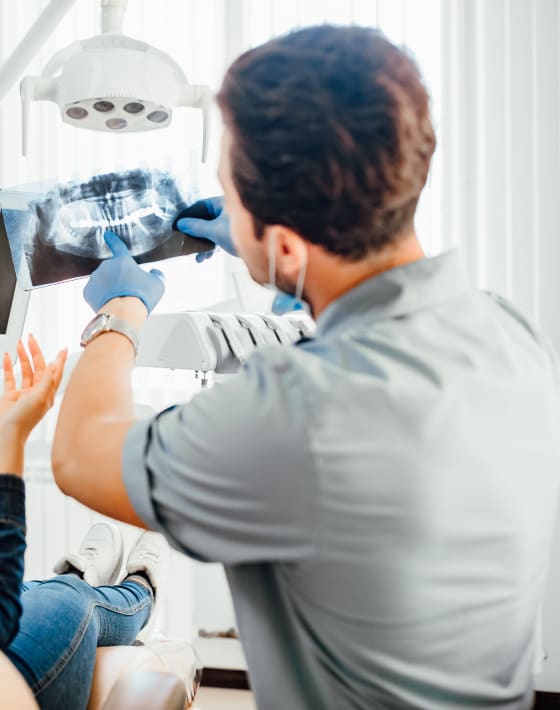
Dentists use the images produced by this specialised dental X-ray to confidently diagnose and plan dental procedures so that you get the best treatment.
An OPG scan is a non-invasive dental imaging procedure, suitable for most patients, including children. The radiation exposure risk is minimal.
OPG scans are quick, over in just a few minutes. You’ll have your completed images within a few days, which you can easily and securely send to your dentist.
OPG scans require minimal planning. Let your radiographer know if you’re pregnant or if you think you might be. X-rays are generally considered safe, but you may be advised to consider alternatives. Before your dental X-ray, you should:
This is for your comfort and hygiene.
This prevents blurring or 'artifacts' from obscuring the images.
This makes sure they don't distort the images.
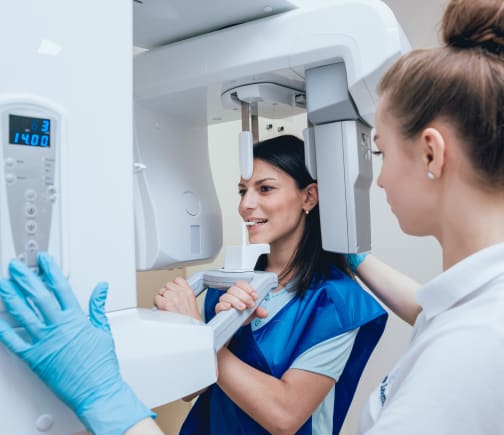
At your OPG scan appointment, a medical professional called a radiographer will be present throughout:
Your radiographer will ask you to sit in the centre of the X-ray machine.
They’ll position your head looking forward and ask you to bite onto a plate to ensure your teeth and jaw are aligned correctly.
The X-ray machine will move in a semicircle around your head, taking an image of your mouth from one side of your jaw to the other.
The process will take around 30 seconds to complete, and you won’t feel anything during your X-ray.
Once your scan is complete, you’ll be able to return home and to your normal duties. You’ll also be able to eat and drink as normal afterwards.
Your OPG X-ray results will be ready within a matter of days, and your imaging clinic will send them to you electronically. You can then share them with your dentist.
At Scan.com, there are no queues or waiting lists. Simply choose one of our network of UK-wide clinics for fast, expert imaging results in days, with full clinician support when you need it.
Yes, OPG scans are generally considered safe for most people. They’re non-invasive and painless; however, they will expose you to a very low level of radiation. Radiation at this level is unlikely to cause harm, but your dental team may recommend that you don’t have a dental X-ray if you’re pregnant.
An OPG scan itself takes a few seconds, less than a minute, but allow 15 to 30 minutes for your entire appointment, including paperwork and getting ready for the scan.
Our OPG scans start from just £80. You don't need to have a referral to book with us.
Your dentist can perform a standard “bite” dental X-ray in their dental practice, but this may not provide all the information they need to confidently diagnose an oral problem or plan any surgery or treatment.
If your dentist needs information on the nerves and soft tissue in and around your mouth, as well as information on your teeth and jawbones, they may refer you for a dental CT scan called a cone beam CT scan or CBCT. A CBCT produces a 3D image of the whole mouth.
Meet our team of UK-based dental imaging specialists.
Get the answers you need by booking an expert dental scan with a Scan.com consultant radiologist.

Dr. Khalid Latief
BMSc, MBChB, FRCP, FRCR