
Key takeaways
- Joint pain is common and can affect one or more joints at a time.
-
It can develop suddenly, such as a ligament tear following an accident or a fall, or gradually, due to wear and tear or conditions such as arthritis.
-
Diagnostic scans, including X-rays, MRIs, ultrasounds and CTs, are used to discover the cause of joint pain.
-
Private diagnostic scans provide fast answers and a quicker route to treatment.
Joint pain can affect anyone at any age, but it’s common to experience joint aches and pains as we get older. We might also pick up injuries from exercising and playing sports, develop chronic pain from repetitive movements or experience acute pain following an accident.
Getting a scan will help you understand the reason behind your pain and open the door to treatment.
What Causes Joint Pain?
Joint pain is common. It might start suddenly after an accident, or gradually and get worse over time. Either way, experiencing pain, stiffness and swelling in your joints can interfere with your ability to work, exercise and do the things you enjoy.
The causes of joint pain vary. It’s common to experience joint aches and pains as we age, often due to wear and tear of the cartilage, a type of soft tissue that cushions the joints and acts as a shock absorber. Perimenopausal and menopausal women may also experience joint pain due to loss of oestrogen.
Repetitive motions, such as through exercise and hobbies (running, cycling, playing ball or racquet sports) and work (heavy lifting, twisting, reaching and bending in construction, nursing and other physical jobs), can put pressure on the joints.
Regularly sitting for long periods of time at a desk or in a vehicle, or due to illness or immobility, may also lead to stiff, painful joints.
Specifically, joint pain may be caused by:
- Sprains: Damage to the ligaments, the connective tissue that connects the bones, common in the knee and ankle joint, causing pain and immobility.
-
Strains: Damage to the tendons, the connective tissue that connects the muscles to the bones, more common in the back and lower limbs.
-
Fractures: Broken bones following an accident or smaller stress fractures caused by overuse and often associated with regular exercise or playing sports at a high level.
-
Tendonitis: Inflammation in the tendons, causing pain, fluid buildup and swelling.
-
Bursitis: Inflammation of the small, fluid-filled sacs that cushion the joints, causing aching, swelling and tenderness.
-
Osteoarthritis: Caused by wear and tear to the cartilage in the joints, usually affects one joint, develops slowly and improves with rest.
-
Rheumatoid arthritis: Caused by inflammation, often affects more than one area, can develop fairly quickly and may improve with gentle movement.
-
Infections: Pain, swelling and redness accompanied by fever, shivers and sweating.
-
Gout: Usually affects the big toe, causing sudden, severe pain, redness, heat and swelling.
What Are the Symptoms of Joint Pain?
Any joint can be affected by painful, uncomfortable symptoms, including the knees, hips, ankles, shoulders and elbows. Symptoms can also affect the neck, back and spine.
You may experience joint pain in one or both sides of your body or in one or more joints. As well as pain and discomfort, you may notice:
- Stiffness
-
A reduced range of motion
-
Swelling
-
Heat
-
Redness
-
Bruising
-
Pain when resting or at night
If you’re experiencing joint pain accompanied by a visible change in the shape of your joint, or you feel unwell with a high temperature, shivers and sweating, see a medical professional urgently or call 111.
When Do You Need a Scan for Joint Pain?
Joint pain is common, with most adults experiencing discomfort in one or more joints at some point in their lives. Often, joint pain will improve with rest, ice to the area and over-the-counter pain medication.
But if your symptoms persist for more than two weeks, despite trying to manage them yourself, or they’re getting worse or keep returning, it’s time to get professional medical help to prevent joint pain from interrupting your life in the long-term.
A scan will reveal what’s going on inside your joint to cause your symptoms and help your doctor make a diagnosis and recommend the right treatment.
How is Joint Pain Investigated?
If you visit your GP for joint pain, you may have one or more of the following tests:
- Medical history: Your doctor will ask you questions about your symptoms, medical history and general health and wellbeing.
-
Physical examination: They may then feel around your joint and ask you to move it in certain directions so they can assess your freedom of movement. They’ll be mindful of your discomfort and won't ask you to push yourself too far.
-
Blood tests: You may have some blood tests that check for inflammation, which may suggest an inflammatory condition such as rheumatoid arthritis.
-
Medical imaging scans: Diagnostic scans help doctors discover the cause of joint pain symptoms and make a diagnosis.
-
Joint aspiration: If you have swollen joints, they may refer you for an aspiration procedure. During a joint aspiration, your doctor will numb the area and, sometimes using ultrasound for guidance, use a long, thin needle to draw excess fluid from the joint. This helps relieve your symptoms, and a sample of the fluid may also be sent to a laboratory for testing to detect signs of inflammation, infection or bleeding.
-
Diagnostic arthroscopy: An arthroscopic procedure is performed under general anaesthetic and involves inserting a long, thin camera into the joint through small skin incisions. Surgeons can use this to examine the joint more closely and diagnose the cause of your symptoms. During the procedure, if any tears or loose pieces of tissue, such as cartilage or bone, are discovered, your surgeon will use keyhole tools to repair or remove them.
You may not need all of these tests and investigations. Often, a scan alone will give you the answers you need.
Types of Scans for Joint Pain
Various scans are used to evaluate joint pain and identify the cause. Which one you have will depend on your symptoms.
X-Ray
X-rays are quick, usually taking just a few minutes, and are often used as a ‘first-line’ scan following an injury when broken bones are suspected. Best for assessing bones, rather than soft tissues, they highlight bone fractures, dislocations, joint-space narrowing and abnormalities such as bone spurs.
MRI
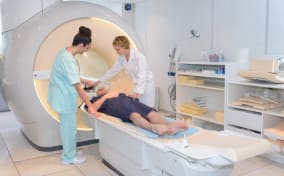
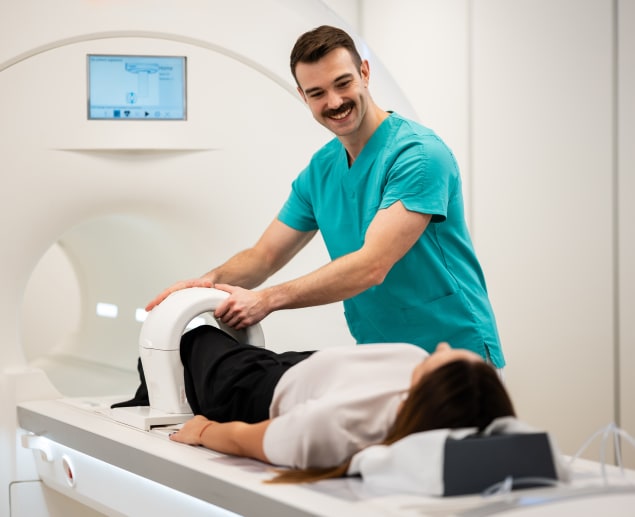
MRI stands for Magnetic Resonance Imaging, and an MRI scanner uses radio waves and a strong magnetic field to create detailed images. They produce detailed images of the bones, joints, soft tissues (including muscles, tendons, and ligaments), organs, nerves, the spinal cord and blood vessels. MRIs are useful for diagnosing soft tissue injuries, sprains, strains, cartilage damage, inflammation, infections, arthritis and tumours.
Unlike X-rays and CT scans, MRIs don’t use ionising radiation, but they take longer, between 30 and 90 minutes, depending on the area being scanned.
Sometimes, patients require an injection of a contrast dye before an MRI to better highlight certain structures. Some patients develop an allergic reaction to these dyes, but you’d be monitored and looked after throughout.
MRIs may be unsuitable if you have certain metallic implants, including cochlear implants, pacemakers, stents, meshes, clips, plates and screws. Your medical team may suggest a different scan, such as a CT scan, if your implants are made of magnetic metal.
You may find an MRI scan difficult if you have claustrophobia, as MRI scanners are large, enclosed machines. If you’re concerned, speak to your medical team, who may be able to suggest a different scan or prescribe a mild sedative.
Ultrasound
Ultrasound scans produce real-time, dynamic images of the inside of the joint. They’re routinely used to detect fluid build-up and diagnose trapped nerves, inflammation, bursitis and calcification.
Because they create moving images, they can detect abnormalities such as bones or soft tissues catching or rubbing against each other as the joint moves. They’re also used to assess cysts, nodules and tumours. Ultrasounds are quick, painless and don’t use ionising radiation.
CT
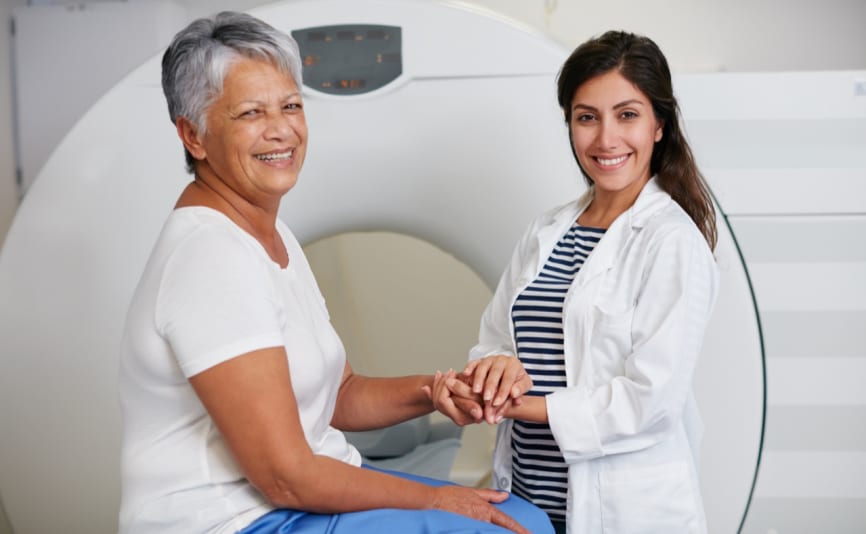
CT stands for computed tomography, and these scans are quick, often taking a few minutes, and are used to create three-dimensional, cross-sectional images of the inside of the body in great detail. They use low-dose radiation and are only used when necessary, often in emergency situations following an accident or when MRI scans are unsuitable.
They’re particularly useful for assessing bone fractures that might not be detected on a standard X-ray and for detecting internal bleeding and blood clots.
Which Scan is Best?
The best scan for you will depend on your symptoms and when and how they started.
- X-ray: Detects bone fractures, dislocations and abnormalities.
-
MRI: Analyses the muscles, ligaments, tendons and cartilage for damage and abnormalities. Often considered the gold standard diagnostic scan for joint pain due to unknown causes.
-
Ultrasound: Detects swelling, fluid build-up and soft tissue injuries, assesses lumps and differentiates between cysts, nodules and tumours.
-
CT: Used in emergency situations to assess trauma following impact and crush injuries, such as a car or mototbike accident or an accident at work.
Get a Scan
You don’t have to live with joint pain. Book a private scan and get answers, fast. We have over 250 scanning centres across the UK, and appointments are typically available within a week. You won’t need a referral letter from your doctor, and you’ll have your results in days.